
Background
Echinacea preparations, principally from Echinacea purpurea (L.) Moench, E. angustifolia DC. and E. pallida (Nutt.) Nutt. (Asteraceae), are used worldwide for the prevention and treatment of respiratory tract infections (RTIs), including the common cold and influenza-like illness. Recent meta-analyses have also reported fewer RTI complications and a reduced need for antibiotics.
Authoritative monographs nevertheless differ in the restrictions they place on use. The HMPC limits continuous use to 10 days and does not recommend use in children under 12 years of age. ESCOP and Health Canada accept preventive use for up to 2 months; Health Canada recommends use from 2 years of age, and the ESCOP monographs support use across all age groups.
The last dedicated safety assessments of oral Echinacea date from 2005 and 2016. A new systematic review and meta-analysis, accepted for publication in Planta Medica in October 2026, re-examines the safety of oral Echinacea preparations within a risk-benefit framework.
Objective
To assess the safety of oral Echinacea preparations on the basis of human clinical studies, to characterise the frequency and severity of reported adverse events (AEs), and to place these findings in a real-world context using spontaneous reports from the EudraVigilance data analysis system (EVDAS).
Selection criteria
Randomised and non-randomised controlled clinical trials of oral Echinacea (all species and preparations, including combination products, in any indication) compared with placebo, active treatment or no treatment were included, provided that safety information was reported. There was no restriction on publication status or patient population. Uncontrolled trials were analysed separately.
Data collection and analysis
The literature search followed the strategy of the ERA-PRIMA meta-analysis (Gancitano et al., 2024). It identified 2434 records from six databases and 15 from other sources. After removal of duplicates, 1041 records were screened and 85 reports were assessed in full text. Forty-eight controlled studies were included (44 randomised and 4 non-randomised).
AEs were coded with MedDRA and classified by System Organ Class (SOC). Where a trial reported only the number of events, the authors assumed that the number of events equalled the number of patients affected. Subgroups were analysed by setting (prevention or acute treatment), type of control, type of preparation (pressed juice or other extracts) and age group.
Pooled AE proportions were compared with the Pearson chi-square test. Risk ratios (RR) with 95% confidence intervals (CI) for experiencing at least one AE were calculated with common and random effects models. A custom search of the frozen EVDAS dataset for the term “Echinacea” was performed in March 2024.
Main results
The 48 controlled studies included 10 115 participants (5389 receiving Echinacea and 4726 receiving a control) and reported 2396 AEs. Nineteen trials were preventive, mostly in healthy individuals (mean treatment duration 61.0 days, up to 6 months), and 29 were therapeutic (mean duration 8.7 days). Thirty-two trials were placebo-controlled. Twenty-six trials used E. purpurea alone. Ethanolic extracts were used in 21 studies and pressed juice in 10. Daily doses ranged from 450 mg to 16 800 mg.
Pooled AE proportions were as follows:
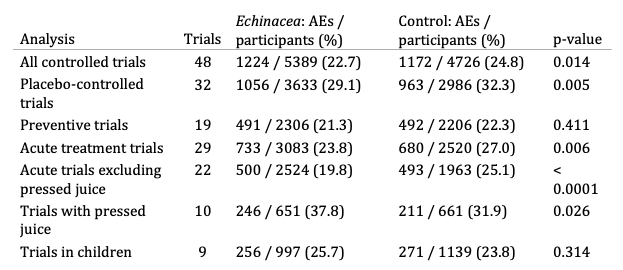
AEs were therefore slightly less frequent with Echinacea than with control overall. The difference arose in acute treatment and was largest when pressed juice preparations were excluded (a relative difference of 21.1%). In trials of pressed juice, AEs were more frequent with Echinacea than with control. No difference was seen in preventive trials or in trials in children.
In the meta-analysis of risk ratios for experiencing at least one AE, the pooled estimate did not differ significantly between Echinacea and control (common effect model: RR 0.98, 95% CI 0.95 to 1.01, p = 0.11; random effects model: RR 1.03, 95% CI 0.88 to 1.21, p = 0.68).
Twenty-five trials allowed classification by SOC. The most frequently affected classes were nervous system disorders such as headache (13.1% of patients with Echinacea versus 12.0% with control), gastrointestinal disorders (11.3% versus 10.7%) and skin and subcutaneous tissue disorders (2.0% versus 2.0%). Immune system disorders were reported in 0.17% versus 0.07%.
Serious AEs were reported in six trials: five in Echinacea groups (0.09%) and four in control groups (0.08%). Of the five with Echinacea, two were injuries unrelated to the study medication, one was a generalised erythema with a pressed juice preparation, and two were hypersensitivity reactions. In one of the latter, it remained unclear whether Echinacea or an excipient was responsible. No fatal events occurred.
Six uncontrolled trials (2152 patients) reported 64 AEs (3.0%), most often gastrointestinal, and no serious AEs.
EVDAS contained 1010 reports of adverse reactions associated with Echinacea-containing products. The most common were gastrointestinal (17.7%), skin and subcutaneous tissue (16.1%), general and administration site (13.1%) and nervous system disorders (10.3%). Most reports came from Europe (83.7%) and from healthcare professionals (66.8%).
Twenty-six EVDAS reports (2.6%) concerned immune system disorders. Ten involved anaphylactic reactions, four of them with intravenous products that are no longer in medicinal use. Only two anaphylaxis cases involved Echinacea mono-preparations and were considered clearly attributable. Four cases of Stevens-Johnson syndrome with possible causality were reported before 2014; none has been indexed in the past 10 years. No fatal adverse reaction to oral Echinacea was identified.
Conclusion
The authors conclude that oral Echinacea preparations have a high level of safety, with qualitative differences between types of preparation. Serious AEs were rare and occurred at a similar frequency to control, and no deaths were recorded among 10 115 trial participants. Preventive use for up to 6 months and use in children aged 1 to 12 years were not associated with more AEs than control.
The lower AE rate seen with ethanolic extracts in acute treatment is interpreted by the authors as a possible reflection of efficacy: shorter and less complicated infections generate fewer events that are recorded as AEs. This is a hypothesis rather than a demonstrated effect.
Implications for practice
The findings support the use of oral Echinacea preparations in the management of RTIs, and the authors favour pharmaceutical-grade ethanolic extracts with defined indications over food supplements of variable composition. Pressed juice preparations were associated with more AEs than control.
Hypersensitivity remains the principal serious concern, although it is rare. The authors advise that caution in patients with known allergy to Asteraceae may still be appropriate.
The data on duration of use and on use in children are relevant to the differing positions of current monographs, and are consistent with the less restrictive position of the ESCOP monographs.
Several limitations should be kept in mind. The significant differences come from comparisons of pooled crude proportions, whereas the pooled risk ratio from the meta-analysis was not significant. AEs could not be distinguished from adverse drug reactions. Methods of recording AEs varied widely across 50 years of trials. Many trials excluded patients with atopy or allergic histories. Under-reporting in pharmacovigilance data is likely, particularly for food supplements.
Implications for research
Standardised collection and reporting of AEs in future trials of herbal medicinal products would allow firmer conclusions. Further preparation-specific safety data are needed, as are additional data on long-term use and on use in children under 12 years. The proposed relationship between efficacy and lower AE rates in acute treatment should be tested prospectively.
Dr. Christopher J. Etheridge. British Herbal Medicine Association (BHMA) Chair
Reference: Ogal M, Willcox M, Bauer R, Johnston SL, Kreft S, Booker A, Schapowal A, Roux D, Gancitano G, Stange R. Safety of Oral Echinacea Preparations: Systematic Review and Meta-Analysis in the Context of Therapeutic Benefit. Planta Med 2026 (accepted manuscript, online 28 October 2026). DOI: 10.1055/a-2992-1199. Accessed 12 November 2026.
More information about Echinacea:
• European Scientific Cooperative on Phytotherapy. ESCOP monographs The Scientific Foundation for Herbal Medicinal Products. Online series. Echinaceae purpureae herba (Purple Coneflower Herb). Exeter: ESCOP; 2021.
• European Scientific Cooperative on Phytotherapy. ESCOP monographs The Scientific Foundation for Herbal Medicinal Products. Online series. Echinaceae purpureae radix (Purple Coneflower Root). Exeter: ESCOP; 2021.
• European Scientific Cooperative on Phytotherapy. ESCOP monographs The Scientific Foundation for Herbal Medicinal Products. Online series. Echinaceae angustifoliae radix (Narrow-leaved Coneflower Root). Exeter: ESCOP; 2019.
• European Scientific Cooperative on Phytotherapy. ESCOP monographs The Scientific Foundation for Herbal Medicinal Products. Online series. Echinaceae pallidae radix (Pale Coneflower Root). Exeter: ESCOP; 2018.