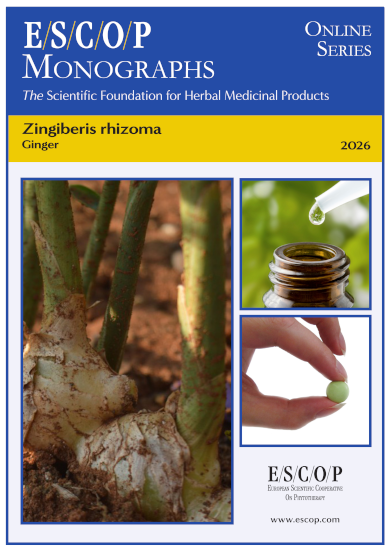
Zingiberis rhizoma
Ginger
Zingiber officinale Roscoe.
Published 2026
Format: PDF, 73 pages
 Online viewing (for only €30 per year, you can view online all the monographs; free for members of societies belonging to ESCOP)
SUMMARY
Herbal drug definition
Zingiberis rhizoma consists of the whole or cut rhizome of Zingiber officinale Roscoe, with the cork removed either completely or only from the wide, flat surfaces.
Main characteristic constituents
The main characteristic constituents of ginger include:
• an oleoresin containing pungent principles, particularly homologues of gingerol, mainly 6-gingerol;
• gingerdione;
• shogaol;
• diarylheptenones;
• gingerdiol and related compounds;
• an essential oil composed mainly of sesquiterpene and monoterpene hydrocarbons.
These constituents are considered relevant to the pharmacological profile of ginger, especially in relation to its gastrointestinal, antiemetic, anti-inflammatory and other biological activities.
Therapeutic indications
According to the ESCOP monograph, ginger is used mainly in relation to nausea, vomiting and mild gastrointestinal complaints.
Nausea and vomiting
Ginger is used for the prophylaxis of nausea and vomiting associated with:
• motion sickness;
• early pregnancy, under medical supervision;
• the post-operative period, particularly after mainly short surgical procedures.
Mild gastrointestinal complaints
Ginger is also relevant for the symptomatic treatment of mild gastrointestinal complaints, particularly where effects on gut motility, digestive function and nausea are clinically relevant.
Administration and clinical use aspects
he ESCOP monograph provides practical information on the clinical use of ginger, including:
• posology;
• duration of use;
• contra-indications;
• special warnings;
• special precautions for use;
• interactions with other medicinal products and other forms of interaction;
• use in pregnancy and lactation;
• effects on ability to drive;
• undesirable effects;
• overdose.
Pharmacological evidence
In vitro experiments
In vitro studies with ginger extracts or their constituents have reported several biological activities, including:
• antiemetic and antinauseant effects involving 5-HT receptors;
• effects on gastric motility;
• effects on gut bacteria and microbiota;
• antioxidant activity;
• anti-inflammatory activity.
These findings help to explain possible mechanisms of action, particularly in relation to gastrointestinal function, but should not be interpreted alone as direct evidence of clinical efficacy.
In vivo experiments
In vivo studies with ginger, its extracts or constituents have described:
• effects on nausea and vomiting;
• effects on gastrointestinal motility;
• effects on salivary flow;
• anti-inflammatory activity;
• antinociceptive activity;
• immunomodulatory effects;
• effects related to metabolic syndrome.
These experimental findings support the pharmacological interest of ginger, although their translation into clinical practice requires careful interpretation.
Pharmacological studies in humans
Human pharmacological studies have mainly investigated:
• gastrointestinal effects on gut motility;
• effects on gut flora;
• anti-inflammatory effects;
• analgesic effects;
• antithrombotic and anticoagulant effects.
These data contribute to understanding the potential clinical relevance of ginger, especially in gastrointestinal and inflammatory contexts.
Clinical studies
Controlled clinical studies have investigated the potential effectiveness of ginger in nausea and vomiting associated with:
• motion sickness;
• surgical procedures;
• medication, including cancer chemotherapy;
• pregnancy.
Other clinical studies have explored anti-inflammatory, analgesic and anti-metabolic syndrome effects.
The available evidence supports the clinical interest of ginger, particularly for nausea and vomiting, while other areas require careful evaluation according to the quality and scope of the studies.
Pharmacokinetic data
Pharmacokinetic properties of ginger and its extracts have been assessed in both animals and humans.
These studies contribute to understanding the absorption, metabolism and disposition of ginger constituents, although their clinical implications should be interpreted in the context of the available evidence.
Safety data
Preclinical safety data for ginger have been assessed in toxicity studies.
Clinical safety data have also been evaluated in human studies. As with other herbal medicinal products, attention should be paid to contraindications, possible interactions, use during pregnancy and lactation, undesirable effects and duration of use.
Particular caution may be relevant when ginger is used together with medicines affecting coagulation or platelet function, or in patients requiring close clinical monitoring.
Clinical interpretation
• Ginger is mainly relevant for the prevention and management of nausea and vomiting, especially in motion sickness, early pregnancy under medical supervision and the post-operative setting.
• Its traditional and clinical relevance also includes mild gastrointestinal complaints.
• Experimental studies suggest several mechanisms of action, including effects on 5-HT receptors, gut motility, inflammation and oxidative stress.
• Pharmacological and clinical findings should be interpreted according to the strength and relevance of the available evidence.
• Safety aspects, contraindications, possible interactions and patient-specific factors should be considered before recommendation.
Literature selection
The literature cited in the monograph is selected to bring together relevant information on the possible physiological roles of ginger and its major constituents, with particular attention to efficacy, dosage and safety.
Keywords
Zingiberis rhizoma; ginger; Zingiber officinale Roscoe; nausea; vomiting; motion sickness; early pregnancy; post-operative nausea and vomiting; mild gastrointestinal complaints; gut motility; antiemetic activity; 5-HT receptors; anti-inflammatory activity; analgesic effects; safety; phytotherapy.
Reference
European Scientific Cooperative on Phytotherapy. ESCOP monographs The Scientific Foundation for Herbal Medicinal Products. Online series. Zingiberis rhizoma (Ginger). Exeter: ESCOP; 2026.