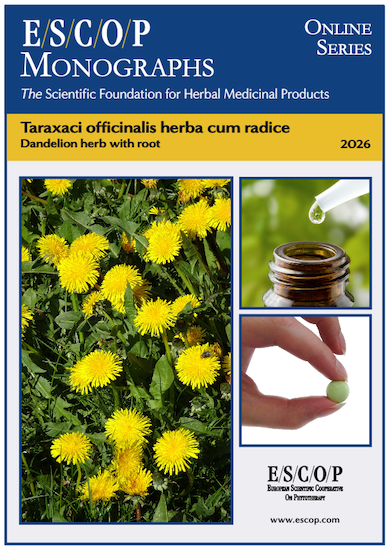
 Online viewing (for only €30 per year, you can view online all the monographs; free for members of societies belonging to ESCOP)
Taraxaci officinalis herba cum radice
Dandelion herb with root
Taraxacum officinale F.H.Wigg
Summary
Herbal drug definition
Taraxaci herba cum radice consists of the whole or fragmented, dried aerial and underground parts of Taraxacum officinale F.H.Wigg.
Main characteristic constituents
- Sesquiterpene lactones, mainly of the germacranolide type;
- Triterpene esters and free triterpenols;
- Flavonoids;
- Hydroxycinnamic acids;
- Coumarins, inluding cichoriin and aesculin;
- Polysaccharides
- Minerals, particularly potassium
These constituents are considered relevant to the pharmacological profile of the herbal drug, although their individual contribution to the clinical effects has not been fully established.
Therapeutic indications
Digestive disorders
- Loss of appetite
- Dyspeptic complaints, such as:
- bloating
- flatulence
- Biliary flow disturbances
In this context, the herbal drug is mainly considered for its traditional use in supporting digestive and hepatobiliary function.
Urinary disorders
- Ailments where enhanced urinary output is desirable, for example:
- rheumatism
- prevention of renal gravel
This use should be understood as supportive and related to the promotion of diuresis, rather than as a substitute for medical evaluation or treatment of renal, rheumatic or urinary tract disease.
Administration and clinical use aspects
Monograph includes information about:
- Posology
- Duration of use
- Contra-indications
- Special warnings
- Special precautions for use
- Interactions with other medicinal products and other forms of interaction
- Use in pregnancy and lactation
- Effects on ability to drive
- Undesirable effects
- Overdose
In vitro experiments
In vitro experiments with dandelion herb with root demonstrated:
- Anti-diabetic activity
- Anti-adipogenic activity
- Anti-inflammatory activity
- Anti-viral activity
These findings help to describe possible mechanisms of action, but they should not be interpreted as direct evidence of clinical efficacy in humans.
In vivo experiments
In vivo experiments with dandelion herb with root or its extracts demonstrated:
- Choleretic properties
- Gastroprotective properties
- Diuretic properties
- Nephroprotective properties
- Hepatoprotective properties
- Anti-inflammatory properties
- Anti-diabetic properties
- Anti-adipogenic properties
These experimental findings support further investigation of the herbal drug, but their translation into clinical practice requires caution.
Pharmacological studies in humans
Pharmacological studies in humans concern effects on:
- Frequency of urination
- Increases in the urinary excretion ratio
- Increases in the relative amount of Tamm-Horsfall protein/creatinine ratio in urine
The available human data are relevant to the traditional use of the herbal drug in urinary disorders, but should be considered limited in scope.
Safety data
Preclinical safety data for dandelion herb with root were assessed in toxicity studies.
Safety data concerning an allergic potential were assessed in patch tests in humans.
As with other herbal drugs, attention should be paid to patients with known hypersensitivity, patients with hepatobiliary or renal disorders and pregnant or breastfeeding women.
Clinical interpretation
- Dandelion herb with root is mainly relevant for mild digestive complaints and for situations where increased urinary output is desirable;
- experimental pharmacological findings should be distinguished from established therapeutic indications;
- safety, contraindications, possible interactions and duration of use must be considered before recommendation;
- persistent, severe or unexplained symptoms require medical assessment.
Literature selection
The selection of literature cited in the monograph is aimed at bringing together relevant information about the possible physiological roles of dandelion herb with root and its major constituents.
Keywords
Taraxaci herba cum radice; dandelion herb with root; Taraxacum officinale F.H.Wigg.; digestive disorders; loss of appetite; dyspeptic complaints; bloating; flatulence; biliary flow disturbances; urinary disorders; diuresis; rheumatic complaints; renal gravel.
Reference
European Scientific Cooperative on Phytotherapy. ESCOP monographs The Scientific Foundation for Herbal Medicinal Products. Online series. Taraxaci herba cum radice (Dandelion herb with root). Exeter: ESCOP; 2026.