• Skip to primary navigation
  • Skip to main content
  • Skip to primary sidebar

ESCOP

European Scientific Cooperative on Phytotherapy

CHOOSE YOUR ACCESSVIEWING DOWNLOAD

  • Home
  • About
    • Members
    • Directors
    • Scientific Committee
    • Supervising Editors
  • Monographs
    • Download
    • Online viewing
      • Subscription
    • ESCOP Monographs: from print format to online availability
  • Testimonials
  • News
  • Publications
  • Contact us
  • Mailing List
  • Login
  • 0 items0,00€
You are here: Home / Downloads / Coriandri fructus (Coriander fruit)

Coriandri fructus (Coriander fruit)

By Bernat on November 4, 2026

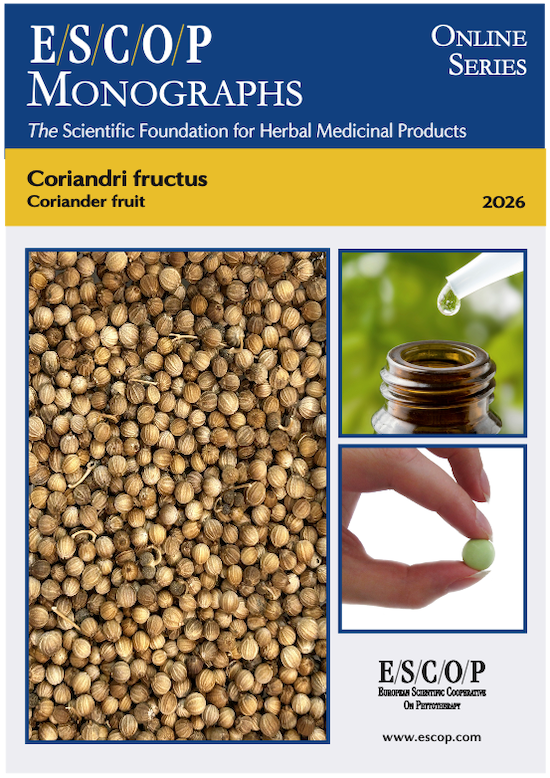
Coriandri fructus

Coriander fruit

Coriandrum sativum L.

Published: November 2026

PDF, 15 pages

Online viewing (for only €30 per year, you can view online all the monographs; free for members of societies belonging to ESCOP)

Checkout Added to cart


Summary

🌱 Herbal drug definition

Coriander fruit consists of the dried cremocarp of Coriandrum sativum L.

🧪 Main characteristic constituents

• Essential oil, predominantly D-(+)-linalool (60-70%) and monoterpene hydrocarbons • Fatty acids • Hydroxy- and furanocoumarins • Flavonoids and catechin derivatives • Amides and amino acids • Phenolcarbonic acids These constituents are considered relevant to the pharmacological profile of the herbal drug, although their individual contribution to the clinical effects has not been fully established.

🎯 Therapeutic indications

According to the ESCOP monograph, coriander fruit is mainly considered for its traditional use in supporting digestive functions for mild digestive complaints, including: • Loss of appetite • Complaints of the upper abdomen • Prevention of diarrhoeal diseases

📋 Administration and clinical use aspects

The ESCOP monograph provides information on the practical and clinical use of coriander fruit, including: • Posology: Oral use: 0.1 g coriander fruit two to three times daily. Topical use: 6% coriander fruit in ointment • Duration of use: No restriction • Contra-indications: None known • Special warnings/precautions: Coriander fruit possesses a weak potential for sensitization • Interactions with other medicinal products and other forms of interaction: None known • Use in pregnancy and lactation: No data available • Undesirable effects: Coriander fruit is known to give rise to allergic reactions • Overdose: No cases reported

🔬 Pharmacological evidence

In vitro experiments In vitro studies with coriander fruit or its constituents have reported several biological activities, including: • Anti-inflammatory activity • Anti-bacterial activity These findings help to describe possible mechanisms of action, but they should not be interpreted as direct evidence of clinical efficacy in humans In vivo experiments In vivo studies with coriander fruit or its extracts have described: • Hepato- and nephroprotective properties • Anti-hyperglycaemic properties • Anti-inflammatory properties • Anti-hyperlipidaemic properties • Cardioprotective properties • Sedative, anxiolytic and neuroprotective properties These experimental findings support further investigation of the herbal drug, but their translation into clinical practice requires caution Clinical studies Clinical studies have mainly investigated effects related to metabolic syndrome: • Hypo-glycaemic effects • Hypo-lipidaemic effects • Anti-oxidant effects

⚠️ Safety data

Preclinical safety data for coriander fruit have been assessed in toxicity studies. The allergic potential of the herbal drug has also been evaluated in human specific IgE, skin prick and basophil activation tests. As with other herbal drugs, attention should be paid to patients with known hypersensitivity, patients with hepatobiliary disorders and pregnant or breastfeeding women.

💡 Clinical interpretation

  • Coriander fruit is mainly relevant for mild digestive complaints;
  • experimental pharmacological findings should be distinguished from established therapeutic indications;
  • safety, contraindications, possible interactions and duration of use must be considered before recommendation;
  • persistent, severe or unexplained symptoms require medical assessment.

📚 Literature selection

The selection of literature cited in the monograph is aimed at bringing together relevant information about the possible physiological roles of coriander fruit and its major constituents.

Keywords: Coriandri fructus; coriander fruit; Coriandrum sativum L.; digestive disorders; loss of appetite; complaints of the upper abdomen; prevention of diarrhoea.

Reference: European Scientific Cooperative on Phytotherapy. ESCOP monographs The Scientific Foundation for Herbal Medicinal Products. Online series. Coriandri fructus (Coriander fruit). Exeter: ESCOP; 2026.

Checkout Added to cart

Primary Sidebar

Join us

Subscribe to our Newsletter

Therapeutic indications (access to summaries and purchase)

  • Fungal infections of the skin (1)
  • Monograph (91)
    • Circulatory disorders (14)
      • Arterial hypertension (1)
      • Haemorrhoids (10)
        • Haemorrhoids (oral administration) (2)
        • Haemorrhoids (stools softener) (4)
        • Haemorrhoids (topical application) (4)
      • Microcirculatory disorders of the eye (1)
      • Mild cardiac complaints of nervous origin (1)
      • Peripheral vascular insufficiency (1)
      • Venous insufficiency (chronic) (5)
        • Varicose veins (oral administration) (3)
        • Varicose veins (topical administration) (2)
    • CNS disorders (10)
      • Cognitive impairment (1)
      • Depressive disorders (1)
      • Difficulty in falling asleep (2)
      • Exhaustion mental or physical (3)
      • Fatigue (3)
      • Headache (1)
      • Irritability (3)
      • Migraine prophylaxis (1)
      • Restlessness (4)
      • Tenseness (3)
    • Dermatological disorders (21)
      • Abrasions (2)
      • Acne (2)
      • Atopic dermatitis (1)
      • Bruises (4)
      • Cold sores (1)
      • Dermatitis (9)
      • Eczema (2)
      • Furuncles (1)
      • Herpes labialis (1)
      • Hyperhidrosis (2)
      • Insect bites (5)
      • Psoriasis (1)
      • Seborrhoea (2)
      • Skin inflammation (12)
      • Sunburn (1)
      • Wounds (7)
    • Digestive disorders (42)
      • Appetite loss (10)
      • Bloating (12)
      • Colitis (1)
      • Constipation habitual (3)
      • Constipation ocassional (6)
      • Diarrhoea (unspecific) (10)
      • Diverticulosis (1)
      • Dyspeptic complaints (19)
      • Enteritis (2)
      • Fissure anal (4)
      • Flatulence (11)
      • Gastritis (6)
      • Gastrointestinal complaints (8)
      • Heartburn (1)
      • Hepatobiliary disturbance (3)
      • Irritable bowel syndrome (3)
      • Nausea and vomiting due to motion (1)
      • Nausea and vomiting in early pregnancy (1)
      • Spasmodic gastro-intestinal complaints (6)
    • Gynecological disorders (5)
      • Dysmenorrhoea (4)
      • Menopause (2)
      • Menorrhagia (1)
    • Metabolic disorders (4)
      • Diabetes (1)
      • Hypercholesterolaemia – Dyslipidaemia (4)
    • Mouth, ear, nose and throat disorders (18)
      • Anaesthetic dental (1)
      • Aphthous ulcers (3)
      • Dental healthcare: disinfectant mouthwash (1)
      • Gingivitis (5)
      • Inflammation of the oropharyngeal mucosa (13)
      • Pharyngitis (10)
      • Sore throat (2)
      • Stomatitis (10)
      • Tonsillitis (1)
    • Pain and inflammation (6)
      • Contusions (2)
      • Epicondylitis (1)
      • Low back pain (2)
      • Musculoskeletal inflammations (5)
      • Myalgia (2)
      • Osteoarthritis (3)
      • Periarthritis (2)
      • Rheumatic complaints (5)
      • Tendinitis (1)
    • Respiratory disorders (23)
      • Bronchitis (1)
      • Catarrh of the respiratory tract (14)
      • Common cold (12)
      • Cough (7)
      • Fever (3)
    • Urinary disorders (16)
      • Bacterial infections of the urinary tract (8)
      • Benign prostatic hyperplasia (3)
      • Cystitis (2)
      • Irrigation of the urinary tract (10)
      • Irritable bladder (2)
      • Urinary lithiasis (6)

Example of monograph

Psylli semen

Lists of monographs

  • List of monographs (online viewing)
  • List of monographs (download)

Privacy Policy and Disclaimer

Privacy Policy and Disclaimer

Are you looking to boost your knowledge?

Join us

Subscribe to our Newsletter

Members

AUSTRIA · GERMANY · ITALY · NETHERLANDS · POLAND · PORTUGAL · SPAIN · SWITZERLAND · TURKEY · TURKEY · UNITED KINGDOM

Copyright © 1999-2024 ESCOP · Developed by Cita Publicaciones · Privacy Policy and Disclaimer